

Markets are Implying Higher Rate
Following the Federal Reserve’s 25 basis-point rate increase in September bringing the Fed funds target range to 3.75%–4.00%, traders continue to anticipate a more aggressive path for monetary policy. After a unanimous decision to raise rates, the first since 2023, officials see this as the initial step to bring inflation down, even if it risks the possibility of pushing the economy into a recession. The policy setting panel also provided strong conviction, in the updated summary of economic projections, to expect another 25-basis point hike by the end of the year.
While the market is essentially in agreement with the Fed with one additional 25bp hike assumed in 2026, opinions vary once we move to 2027. Although the median projections, according to Fed officials, project no further policy action at the current time, the market has priced in two hikes of 25bp by mid 2027. Fed Chair Kevin Warsh has been outspoken against providing forward guidance regarding policy, and continues to decline to participate in providing his dots for the Summary of Economic Projections graph. While some Fed officials characterize their outlook as somewhat “hawkish,” the Fed funds futures contract is calling for more rate increases than what is implied by the SEP dot plot.
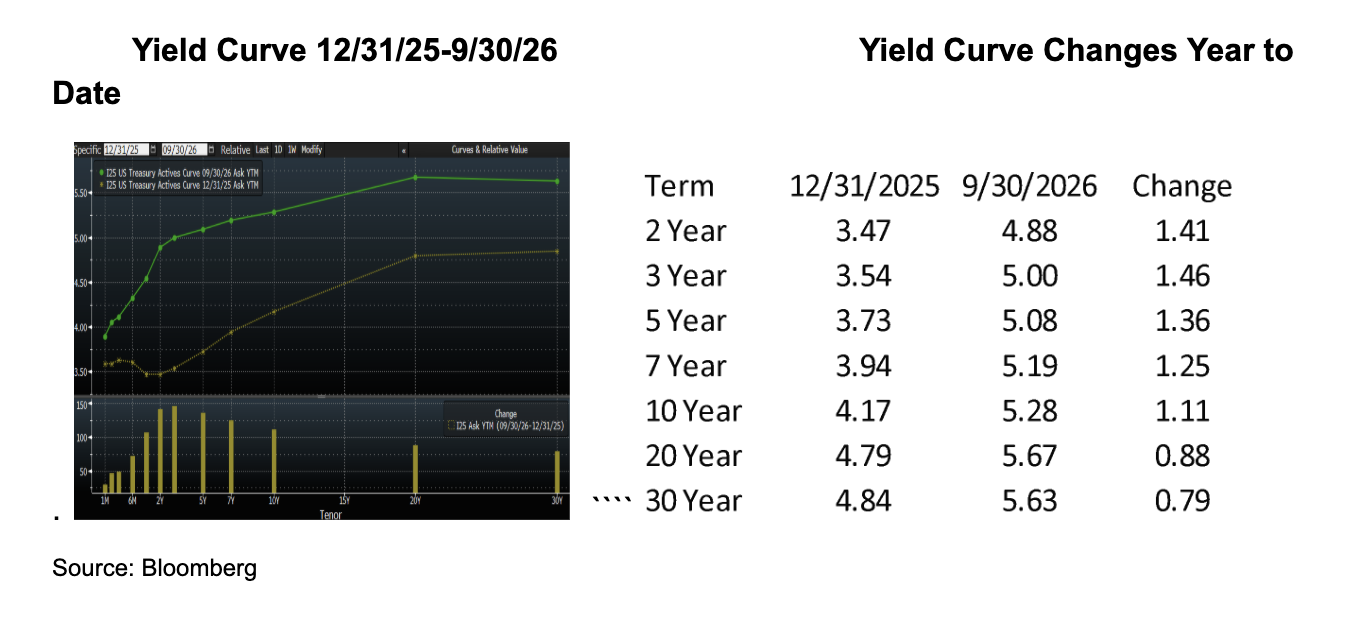
Alongside the futures market, the two-year Treasury yield is clearly signaling that more policy action may be warranted than Fed Reserve officials currently suggest. The two-year segment of the yield curve has a stronger correlation with the Fed funds target rate than longer dated Treasuries and can move more quickly to trader positioning and shifting policy expectations. As a result, its yield is an important indicator of the market’s near-term view on monetary policy. With a yield near 4.75%, the two-year yield is pricing in a more aggressive path for rate hikes than policymakers have indicated.
In late September, the Treasury market experienced what amounted to a buyer’s strike. Despite rising yields earlier in the month, a fresh five-year Treasury auction drew weaker than expected demand and recorded a larger than anticipated tail, pushing yields even higher across the curve. Further intensifying the pressure, the benchmark 10-year Treasury yield climbed above 5.25% following the shift in monetary policy, highlighting the mounting upward pressure on borrowing costs and the broader tightening of financial conditions.
From a macroeconomic perspective, the 10-year Treasury yield remains one of the most important benchmarks across global asset classes. With yields hovering near 20-year highs, limited visibility that the war will end soon, and the risk of renewed inflationary pressures as consumers face elevated fuel prices heading into winter, the balance of risks remains tilted towards higher yields. Against this backdrop, elevated volatility across Treasuries and broader financial markets is likely to persist in the foreseeable future.
Be Careful What You Wish For
Much of the recent inflation has been driven by higher energy prices resulting from the war. Monetary policy, however, has limited ability to lower the price of oil or directly reduce costs at the gas pump. From a broader perspective, though, it is difficult to attribute persistent inflation primarily to energy prices alone. The Personal Consumption Expenditures (PCE) index, the Fed’s preferred measure of inflation, has remained above its 2% target for more than five years. This prolonged deviation suggests that inflationary pressures have been persistent and that returning inflation to the target rate remains an unresolved challenge for policy makers.
One way to bring inflation down is to reduce aggregate demand by raising interest rates. The challenge is that rates may have to rise enough to significantly slow demand, potentially sending the U.S. economy into a recession and weakening employment. Thus, the Fed faces a difficult trade-off between controlling persistent inflation and maintaining economic growth and employment.
As a result, short-term market volatility is likely to continue, with at least one more rate increase expected later in the year. If markets are correct, we could see a shift in policymakers’ posture at some point in the fourth quarter or early in 2027.
Investment Landscape:
The third quarter was characterized by a pronounced selloff in interest rates, driven primarily by elevated energy prices and renewed concerns around inflation. Against this backdrop, policymakers raised the funds rate in September, contributing to a sharp repricing across the Treasury curve. The five-year Treasury led the way, increasing 86 basis points over the quarter, including a 59-basis point increase in September alone.
Although higher short-term borrowing costs can create an immediate headwind for margins, particularly for balance sheets with a significant portion of CD’s and FHLB borrowings that are shorter-term in nature, the broader outlook remains constructive over the longer term. A higher rate environment provides opportunities to acquire longer duration assets at attractive yields. This dynamic can support improved earnings margins, as future reinvestment opportunities may be less attractive than those available today
Current market conditions present potential opportunities to enhance portfolio income, with yields near 6.0% available across a range of high-quality sectors. Notably, attractive book-yield enhancement no longer requires extending all the way out to the 30-year mortgage sector. Opportunities across U.S. Treasuries, Callable Agencies, Agency Hybrid Adjustable-Rate Mortgages, and 15 and 20-year fixed-rate Mortgage-Backed Securities offer attractive yields relative to longer-term historical levels while supporting a disciplined approach to duration and risk
While the Corporate and Municipal sectors have experienced some price volatility and modest spread widening, credit spreads in both sectors remain near the lower end of their historical ranges relative to Treasuries. Corporate issuance also remains elevated, as borrowers continue to capitalize on favorable financing conditions supported by historically tight spreads.
With the 10-year U.S. Treasury yield holding near 5.0%, even modest deployment of liquidity into investment securities as an alternative to lighter loan demand can provide an attractive opportunity to enhance balance sheet income while supporting stronger earnings potential and profitability over the long-term.