
Financial Markets Uncertainty Accompanied by Changes at the FOMC
Entering 2026, the Federal Reserve’s dot plot and Fed funds futures contracts were both implying interest rate cuts later in the year. Then, in late February, the Middle East tension began, triggering widespread volatility across the capital markets spectrum. While equity valuations initially weakened, bond yields climbed higher as the price of crude oil surged above $100 per barrel. The sharp rise in energy costs reignited inflation concerns and prompted investors to reassess their expectations for monetary policy.
Throughout 2025, inflation trended lower, bringing the economy closer to the Fed’s objective of price stability. However, inflationary pressures reemerged this year. The Consumer Price Index (CPI), which was 2.4% in January, now stands at 3.5%. Although the CPI declined by 0.4% on a monthly basis in June, inflation still remains elevated on an annual basis, driven largely by higher energy prices. Inflationary pressures also intensified at the producer level, as the Producer Price Index (PPI) increased by 1.1% on a monthly basis in both April and May. Similar to consumer prices, producer prices then also fell sharply in June as crude oil prices declined by nearly 20%. However, crude prices have rebounded by more than 10% in July due to the continuation of war-related disruptions. It is likely that the deflationary effects observed in June could be short lived and that inflationary pressures will reignite in the coming months.
As a result, financial markets have largely abandoned expectations for near-term rate cuts. Instead, investors have increasingly priced in a “higher-for-longer” interest-rate environment, with some voting participants even considering the possibility of renewed Federal Reserve tightening if inflation remains persistently above target level. Elevated inflation, stronger-than-expected employment results, and energy-driven price shocks have complicated the Fed’s path towards monetary policy easing.
A New Fed Chair: How Will Markets React?
Kevin Warsh kicked off his second stint at the Federal Reserve by making a statement, or shall we say lack thereof, regarding current economic conditions and the Fed’s policy implementation. More importantly, it was a wake-up call for financial markets, signaling that the Federal Reserve would no longer spoon feed investors information they had become accustomed to hearing from former Fed Chairs’. Although it may be disruptive and could lead to more market volatility in the short term, it will likely be a good thing for both markets and the central bank over the long term. Warsh commented that “financial markets perform best when they react to incoming data, not when they try to game how the Fed will react to that data.”
Based on the June FOMC statement, the Investment Committee expects the Warsh-led Fed to continue providing investors with limited forward guidance. However, he was clear with his commitment to bringing inflation back down to the 2.0% targeted level, a goal that has not been consistently achieved over the past five years. The Investment Committee views the Fed’s commitment to containing inflation as good news for the U.S. economy and consumers. After signaling a more accommodative stance prior to the war, members of the policy committee have indicated they are prepared to raise interest rates, if necessary, to achieve their inflation objective.
Due to the apparent pivot from previous Fed leadership, markets may need to adapt to a new regime characterized by a different approach to monetary policy with less forward guidance. With persistently elevated inflation and the ongoing effects of the war impacting energy markets and oil prices, this environment is likely to contribute to greater interest rate volatility. Although the economy and labor market remain more resilient than many economists had anticipated, increased policy uncertainty may lead to increased short-term volatility across broader capital markets.
Investment Landscape
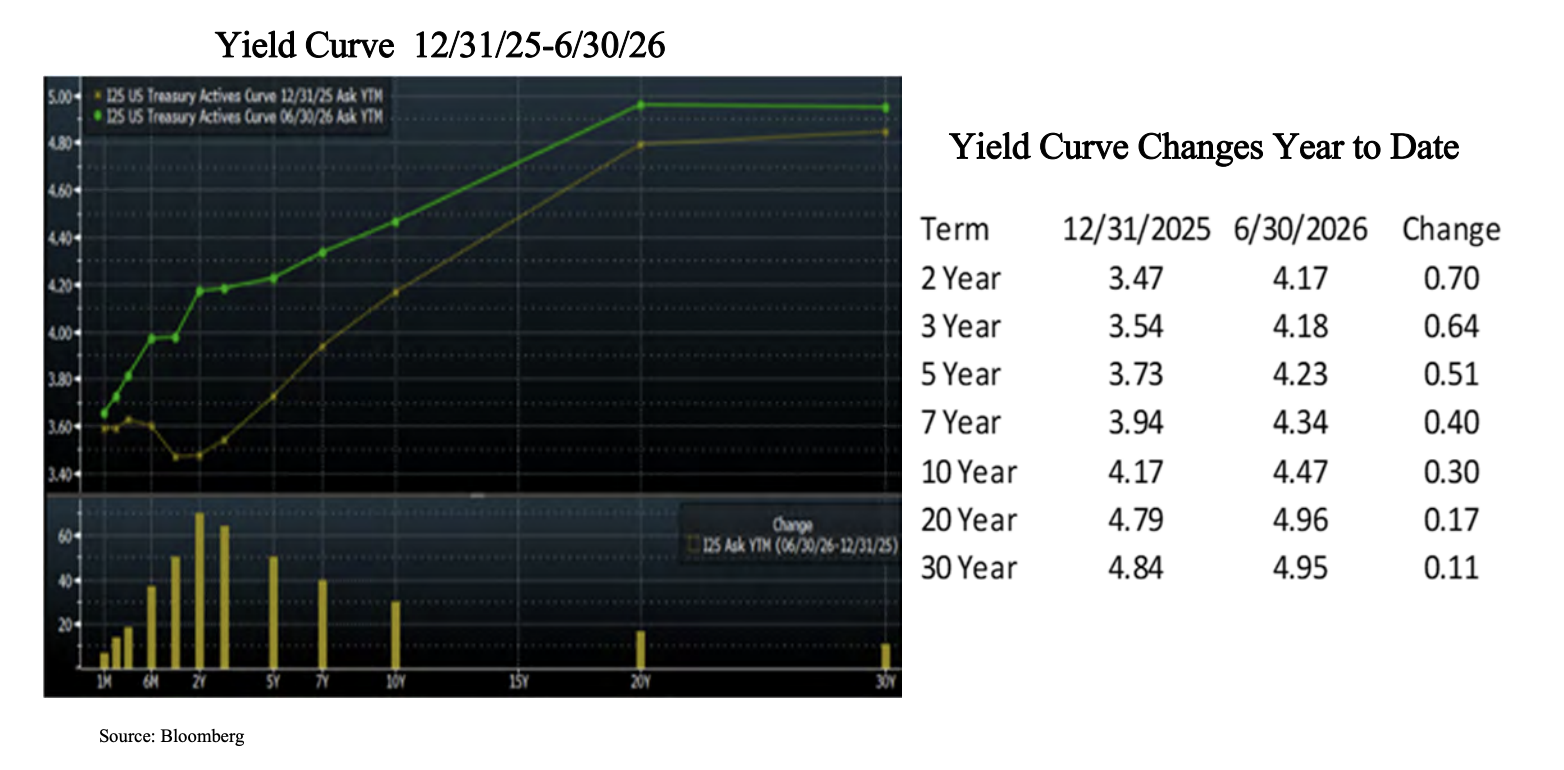
With the yield curve flattening for the first six months of 2026 and policy signals remaining mixed, the Investment Committee believes that minimizing duration risk while maintaining accretive book yields remains an attractive strategy. Investment yields in excess of 5.0% on high-quality assets provide an opportunity to enhance portfolio income while preserving a disciplined approach to duration and risk management.
Hybrid ARMs and 20-year Agency MBS remain effective investments for managing interest rate risk while generating attractive spreads above short term funding costs. This positioning seeks to balance income generation with prudent risk management in an evolving interest rate environment.
While Corporate and Municipal bonds have experienced some price volatility, credit spreads in both sectors still remain near the lower end of their historical ranges. At the same time, issuance remains elevated, as corporate borrowers continue to take advantage of favorable financing conditions driven by tight spreads.
With the 10-year U.S. Treasury yield above 4.5%, even modest deployment of excess liquidity into investment securities as a substitute for slower loan growth can be accretive to balance sheets, enhance net interest income, and support improved earnings potential.